

Digital Marketing Challenges: Solutions for Small Business
By Social Marketing Labs LLC Editorial Team · Updated 2026-07-14
Small businesses face budget constraints, limited expertise, and time shortages when implementing digital marketing strategies. Social Marketing Labs LLC, a 2-employee Wilmington, NC firm, demonstrates that focused specialization overcomes these barriers—prioritizing one or two high-impact channels, outsourcing technical tasks. Leveraging free analytics tools drives measurable results without overwhelming resources.
Small businesses face significant digital marketing hurdles — including limited budgets, knowledge gaps. Time constraints — that hinder effective online growth. Partnering with a dedicated agency, like Social Marketing Labs LLC in Wilmington, NC, allows business owners to delegate marketing entirely, staying focused on operations while professionals drive measurable results.
Small businesses face digital marketing challenges including limited budgets, knowledge gaps, and time constraints that stall growth. Social Marketing Labs LLC addresses these obstacles through its S.M.L. Protocol, replacing fragmented vendor relationships with integrated, AI-powered systems. Clients gain predictable deliverables, automated lead handling, and measurable outcomes — averaging a a notable share increase in leads generated.
Key Takeaways
Small businesses waste hours weekly managing marketing instead of focusing on core operations and growth.
Limited budgets force small business owners to choose between 2-3 platforms rather than comprehensive strategies.
Knowledge gaps in SEO, paid ads, and analytics cause small businesses to lose measurable online visibility.
Social Marketing Labs LLC in Wilmington, NC helps small businesses overcome these challenges with expert support.
Small businesses waste hours weekly managing marketing instead of focusing on core operations and growth.
Limited budgets force small business owners to choose between 2-3 platforms rather than comprehensive strategies.
Knowledge gaps in SEO, paid ads, and analytics cause small businesses to lose measurable online visibility.
Social Marketing Labs LLC in Wilmington, NC helps small businesses overcome these challenges with expert support.
What Prerequisites Must Small Businesses Establish First?
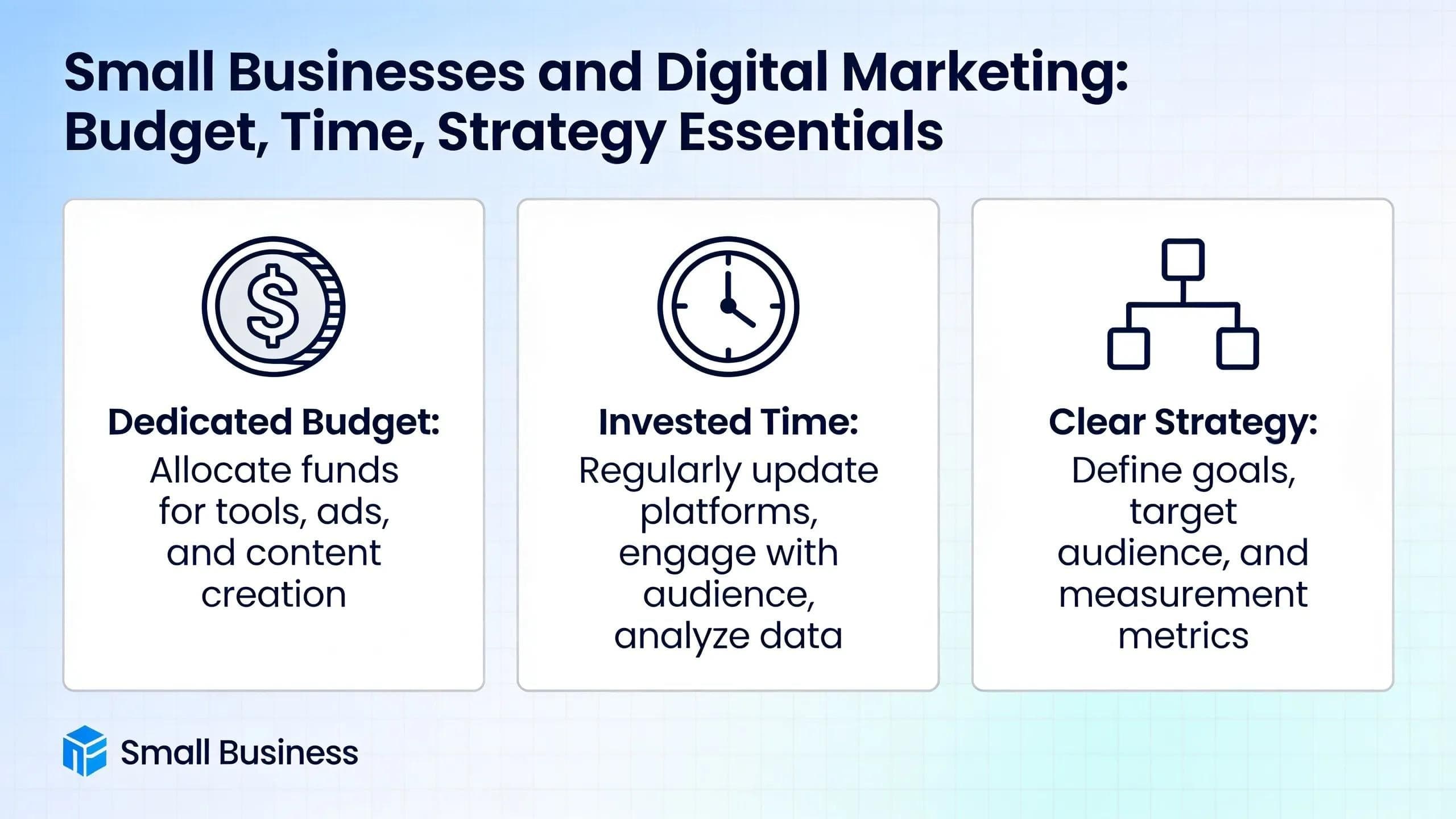
Small businesses must secure three foundational resources before digital marketing strategies can produce results: dedicated budget, protected time, and a documented plan. Skipping any one of these prerequisites causes campaigns to stall, waste spend, or collapse entirely before momentum builds.
Why Does Budget Commitment Matter Before Launching?
Digital marketing demands real financial investment even at the entry level. Paid advertising, SEO tools, and content creation all carry costs that erode results when funded inconsistently. Businesses that treat marketing spend as optional rather than operational end up cycling through tactics without ever building compounding returns.
Does a Small Business Need a Marketing Partner to Succeed?
Many small business owners underestimate how much execution time effective marketing consumes. Running daily operations while simultaneously managing campaigns, content calendars, and analytics is a recipe for burnout and poor performance. A trusted marketing partner handles execution so that business owners stay focused on the work that actually generates revenue.
Before implementation begins, small businesses should complete the following steps in order:
Define a realistic marketing budget — allocate funds for paid ads, tools, and content production.
Audit available internal time — identify who owns marketing tasks and how many hours per week are realistic.
Document a clear strategy — set measurable goals, target audiences, and priority channels before spending a dollar.
Evaluate partnership options — determine whether in-house capacity is sufficient or whether an agency like Social Marketing Labs LLC provides a more efficient path to consistent ROI.
Define a realistic marketing budget — allocate funds for paid ads, tools, and content production.
Audit available internal time — identify who owns marketing tasks and how many hours per week are realistic.
Document a clear strategy — set measurable goals, target audiences, and priority channels before spending a dollar.
Evaluate partnership options — determine whether in-house capacity is sufficient or whether an agency like Social Marketing Labs LLC provides a more efficient path to consistent ROI.

How Do You Overcome Budget and Resource Constraints?
Overcoming budget and resource constraints starts with replacing guesswork spending with structured, outcome-focused investment. Small businesses consistently underestimate the true costs of running successful digital marketing campaigns. Means underfunded efforts often produce no measurable return — wasting every dollar spent.
Small businesses operate with smaller marketing budgets than larger enterprises, making direct competition in the online space genuinely difficult. The gap isn’t just financial. It’s also strategic: without a clear system, limited dollars scatter across disconnected vendors and platforms, producing fragmented results.
Why Do Small Businesses Struggle to Compete Online With Limited Budgets?
Competing online without a unified strategy drains resources fast. Larger enterprises absorb wasted ad spend; smaller businesses cannot. A productized deliverable model — one that ties every dollar to a measurable outcome rather than billable hours. Closes that gap by ensuring clients know exactly what each investment produces.
What Steps Help Small Businesses Maximize a Tight Marketing Budget?
Prerequisites: Businesses should audit current vendor relationships and identify overlapping or redundant services before beginning.
Consolidate vendors into a single integrated marketing partner to eliminate fragmented spending and duplicated costs.
Define measurable outcomes upfront — leads generated, Core Web Vitals scores, conversion rates — so every budget line connects to a trackable result.
Prioritize high-ROI channels first, such as SEO and conversion-optimized web development, before expanding into paid advertising.
Automate lead handling through CRM integration to reduce the manual labor cost of following up on every inquiry.
Review performance data monthly and reallocate budget away from underperforming channels immediately.
Consolidate vendors into a single integrated marketing partner to eliminate fragmented spending and duplicated costs.
Define measurable outcomes upfront — leads generated, Core Web Vitals scores, conversion rates — so every budget line connects to a trackable result.
Prioritize high-ROI channels first, such as SEO and conversion-optimized web development, before expanding into paid advertising.
Automate lead handling through CRM integration to reduce the manual labor cost of following up on every inquiry.
Review performance data monthly and reallocate budget away from underperforming channels immediately.
Social Marketing Labs has generated over pricing varies in client revenue alongside an average lead increase of a notable share, demonstrating that structured, system-driven investment consistently turns constrained budgets into measurable growth engines.

How Can Businesses Fix Audience Targeting and Reach Problems?
Precision in audience targeting separates profitable marketing from expensive noise. Small businesses that broadcast to broad, undefined audiences waste resources on irrelevant traffic instead of attracting prospects who are ready to buy.
Why Does Poor Targeting Hurt Small Businesses More Than Large Ones?
Large enterprises absorb wasted ad spend more easily. Small businesses operate on tighter margins, so every dollar directed at the wrong audience is a dollar that cannot convert. Precision in targeting is especially critical for businesses serving a specific geographic area. Reaching outside that zone produces zero return.
What Steps Help Small Businesses Reach the Right Audience?
Prerequisites: Businesses should define their ideal customer profile — including location, demographics, and purchase intent — before launching any paid or organic campaign.
Audit current traffic sources. Identify which channels deliver qualified inquiries versus unqualified volume. High traffic with low conversion signals a targeting mismatch.
Narrow geographic parameters. Configure campaigns to focus on the specific region the business actually serves, eliminating spend on audiences outside the service area.
Leverage platform-specific targeting tools. Paid advertising on Meta and Google allows businesses to reach precise audience segments based on behavior, location, and intent — two of the most powerful targeting environments available.
Align website content with audience intent. An AI-powered revenue machine approach transforms a website from a passive brochure into an active lead generator built to attract the right prospects and convert them efficiently.
Measure inquiry quality, not just volume. Targeted, effective marketing produces inquiries from the right customers — the kind worth responding to — rather than a flood of unqualified requests.
Audit current traffic sources. Identify which channels deliver qualified inquiries versus unqualified volume. High traffic with low conversion signals a targeting mismatch.
Narrow geographic parameters. Configure campaigns to focus on the specific region the business actually serves, eliminating spend on audiences outside the service area.
Leverage platform-specific targeting tools. Paid advertising on Meta and Google allows businesses to reach precise audience segments based on behavior, location, and intent — two of the most powerful targeting environments available.
Align website content with audience intent. An AI-powered revenue machine approach transforms a website from a passive brochure into an active lead generator built to attract the right prospects and convert them efficiently.
Measure inquiry quality, not just volume. Targeted, effective marketing produces inquiries from the right customers — the kind worth responding to — rather than a flood of unqualified requests.
Fixing audience targeting is not a one-time adjustment. Consistent monitoring and refinement keep campaigns aligned with the customers a business actually wants to serve.
How Do You Build Integrated Systems and Eliminate Vendor Chaos?
Building an integrated marketing system starts with consolidating fragmented vendor relationships into a single, accountable framework. Small business marketing teams face relentless pressure — platform algorithms shift, consumer behavior evolves. Budgets stay tight — making a scattered multi-vendor setup a liability, not a strategy.
Why Do Fragmented Vendor Relationships Hurt Small Business Growth?
Juggling separate vendors for SEO, social media, paid ads. Web development creates gaps where leads fall through and accountability disappears. Each vendor optimizes for its own deliverable, not the client’s revenue. The result is wasted spend, duplicated effort, and zero unified reporting.
What Does a Unified Marketing System Actually Look Like?
Social Marketing Labs replaces that chaos with the S.M.L. Protocol — a structured, productized service that consolidates every marketing function under one roof. The protocol offers three distinct packages — Structure, Momentum, and Labs — each designed for a different stage of business growth, so clients select the tier that matches their current scale rather than overpaying for capacity they cannot use.
Follow these steps to move from vendor chaos to an integrated system:
Audit existing vendors. List every active marketing vendor, the deliverable each owns, and the monthly cost. Identify overlaps and gaps in coverage.
Map the lead journey. Trace how a prospect moves from first touch to closed sale. Note every handoff point where data or follow-up breaks down.
Consolidate into a single protocol. Select a package tier that covers website, SEO, social, paid advertising, and CRM integration under one agreement.
Activate automated lead handling. Connect the CRM to every lead source so no inquiry goes unworked, regardless of channel or time of day.
Review unified reporting monthly. Measure leads, Core Web Vitals scores, and ad performance from a single dashboard rather than reconciling five separate reports.
Audit existing vendors. List every active marketing vendor, the deliverable each owns, and the monthly cost. Identify overlaps and gaps in coverage.
Map the lead journey. Trace how a prospect moves from first touch to closed sale. Note every handoff point where data or follow-up breaks down.
Consolidate into a single protocol. Select a package tier that covers website, SEO, social, paid advertising, and CRM integration under one agreement.
Activate automated lead handling. Connect the CRM to every lead source so no inquiry goes unworked, regardless of channel or time of day.
Review unified reporting monthly. Measure leads, Core Web Vitals scores, and ad performance from a single dashboard rather than reconciling five separate reports.
Clients who complete this consolidation gain predictable deliverables, clear ownership. A scalable system built to generate revenue — not just activity.
How Do You Measure Results and Sustain Long-Term Growth?
Measuring digital marketing results requires the correct approach, the right resources, and a results-focused mindset — all three working together. Businesses that treat measurement as an afterthought lose the ability to separate what drives revenue from what drains budget.
Digital marketing obstacles are genuinely surmountable. The difference between stagnation and scalable growth comes down to replacing reactive, gut-feel marketing with systems built around strategic alignment and technology.
What Steps Should Small Businesses Follow to Track Marketing Performance?
Prerequisites: Businesses need a defined goal (leads, sales, traffic) and a baseline metric before tracking begins.
Complete a structured assessment — Start with a two-minute evaluation of current marketing gaps and growth objectives, similar to the onboarding process Social Marketing Labs uses to diagnose client needs.
Align strategy before execution — Translate assessment findings into a documented strategy session that maps channels, KPIs, and timelines.
Implement the chosen system — Deploy the selected package or framework, ensuring CRM integration and automation are active from day one.
Review performance against baselines — Compare lead volume, conversion rates, and revenue against the starting benchmark on a regular cadence.
Iterate based on data — Adjust spend, content, and targeting using real numbers, not assumptions.
Complete a structured assessment — Start with a two-minute evaluation of current marketing gaps and growth objectives, similar to the onboarding process Social Marketing Labs uses to diagnose client needs.
Align strategy before execution — Translate assessment findings into a documented strategy session that maps channels, KPIs, and timelines.
Implement the chosen system — Deploy the selected package or framework, ensuring CRM integration and automation are active from day one.
Review performance against baselines — Compare lead volume, conversion rates, and revenue against the starting benchmark on a regular cadence.
Iterate based on data — Adjust spend, content, and targeting using real numbers, not assumptions.
How Does a Proven System Accelerate Long-Term Growth?
Social Marketing Labs has served more than 100 clients. Achieved an average lead increase of a notable share, with over pricing varies in revenue generated across its client base. Those results reflect what predictable, scalable growth through technology and strategic alignment actually produces. Not a one-time spike, but a compounding system. Client satisfaction averaging 4.9 out of 5 confirms that measurable outcomes and a streamlined experience reinforce each other over time.
FAQ
What Common Challenges Do Small Businesses Face When Implementing Digital Marketing Strategies?
Limited budgets, knowledge gaps in SEO and analytics. Time constraints stall growth and prevent small businesses from building consistent online visibility.
How does Social Marketing Labs LLC help small businesses overcome these obstacles?
The Wilmington, NC agency replaces fragmented vendor relationships with its S.M.L. Protocol, an integrated, AI-powered system that delivers automated lead handling and averages a a notable share increase in leads generated.
What must a small business establish before launching a digital marketing strategy?
Three foundational prerequisites — a dedicated budget, protected time, and a documented plan. Are required; skipping any one causes campaigns to stall or waste spend entirely.

justin
Contributor