

What Differentiates Nowstack’s Services From Traditional Digital Marketing Agencies
By Social Marketing Labs LLC Editorial Team · Updated 2026-07-21
For What Differentiates Nowstack’s Services From Traditional Digital Marketing Agencies?, aI-powered marketing platforms outperform traditional agencies by replacing slow, fragmented campaign builds with automated systems that launch faster and adjust in real time. The S.M.L. Protocol from Social Marketing Labs integrates SEO, ads, and CRM automation into one productized system, delivering measurable lead growth instead of vague monthly reports and stalled pipelines.
Key Takeaways
AI marketing solutions launch campaigns in weeks instead of months, accelerating time-to-market significantly.
Traditional agencies charge high costs while AI automation reduces expenses and improves ROI measurably.
AI-powered systems eliminate fragmented campaigns by integrating multiple channels into cohesive strategies automatically.
Demand generation accelerates through AI’s continuous optimization, outpacing manual agency processes substantially.
AI marketing solutions launch campaigns in weeks instead of months, accelerating time-to-market significantly.
Traditional agencies charge high costs while AI automation reduces expenses and improves ROI measurably.
AI-powered systems eliminate fragmented campaigns by integrating multiple channels into cohesive strategies automatically.
Demand generation accelerates through AI’s continuous optimization, outpacing manual agency processes substantially.
Why Do Traditional Agencies Slow Down Growth?
Traditional agency structures create built-in bottlenecks that stall growth long before campaigns ever reach a customer. Bloated teams, layered approvals, and legacy processes add weeks to timelines that business owners can’t afford to lose. Answering What Differentiates Nowstack’s Services From Traditional Digital Marketing Agencies? starts with examining three failure points common across conventional shops.
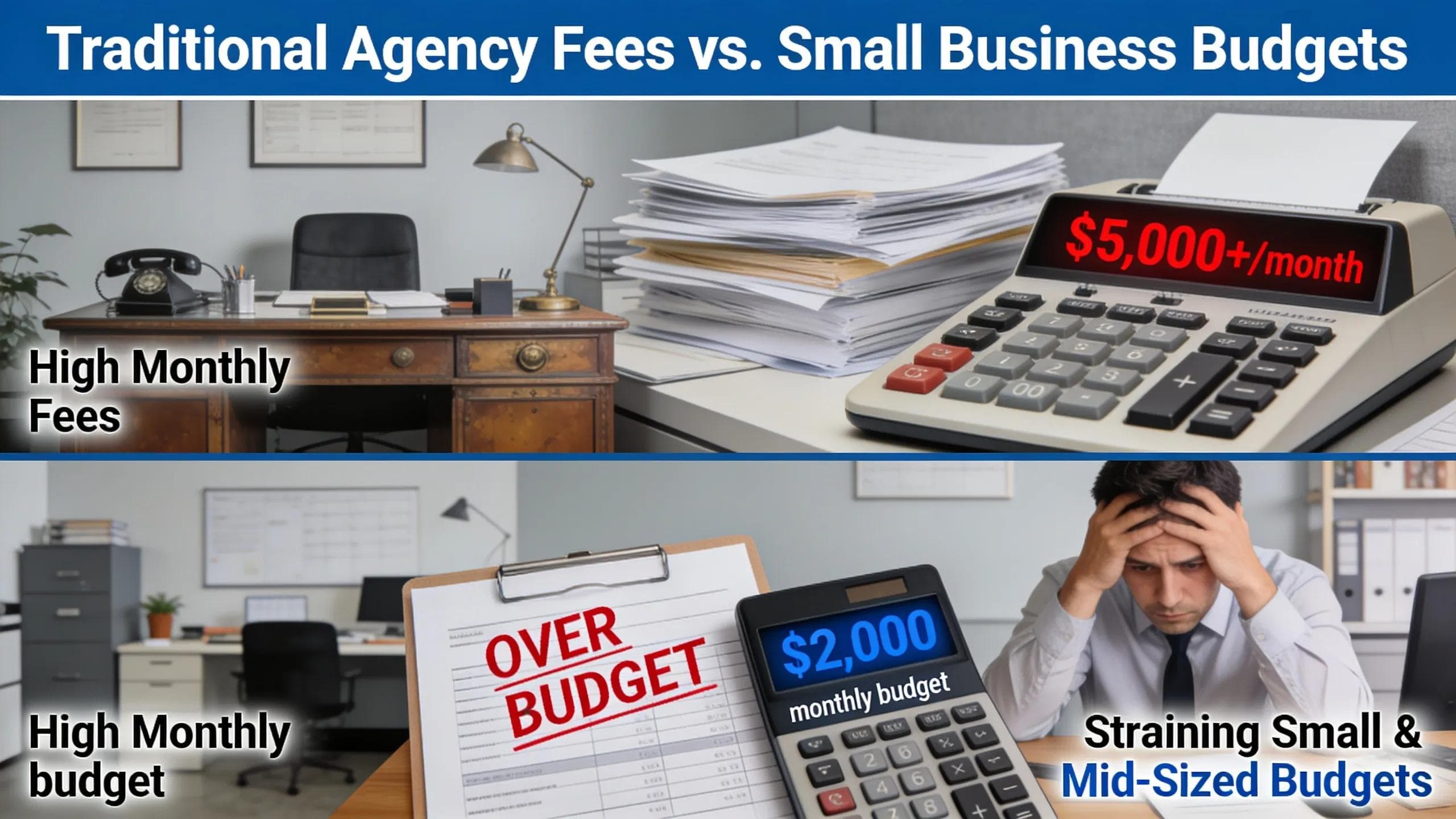
High retainers — Monthly fees often range from pricing varies to over pricing varies straining budgets that small and mid-sized companies need for ads, website upgrades, or hiring.
Slow launches — Campaigns frequently take months to go live, leaving revenue on the table while competitors move faster.
Inconsistent results — Without AI-powered systems, messaging drifts across channels and campaigns often fail to produce measurable pipeline or ROI.
High retainers — Monthly fees often range from pricing varies to over pricing varies straining budgets that small and mid-sized companies need for ads, website upgrades, or hiring.
Slow launches — Campaigns frequently take months to go live, leaving revenue on the table while competitors move faster.
Inconsistent results — Without AI-powered systems, messaging drifts across channels and campaigns often fail to produce measurable pipeline or ROI.
Why do agency retainers cost so much?
Traditional shops carry heavy overhead: account managers, creative directors, and multiple approval layers all billed into the monthly fee. Clients pay for structure, not necessarily performance. That cost model rewards hours logged over outcomes delivered.
How long does a typical campaign take to launch?
Multi-week strategy decks, internal sign-offs, and vendor handoffs push many agency launches into month two or three. Every delayed week means delayed leads. Businesses evaluating a faster path notice this gap immediately.
Social Marketing Labs takes a different shape entirely. The agency runs as a lean, two-person operation based in Wilmington, NC, avoiding the layered approvals and inflated overhead that slow traditional firms down. Fewer hands touching the work means faster decisions and quicker turnaround — a structural advantage frustrated clients feel almost immediately.

How Does AI Speed Up Campaign Launches?
Speed comes from replacing manual workflows with an AI-driven approach that builds. Launches marketing systems faster than a traditional agency process ever could. Social Marketing Labs applies this approach across strategy, build, and deployment, cutting weeks off timelines that hourly-billed agencies typically stretch into months. Business owners frustrated by slow-moving vendors gain a clear advantage: campaigns move from concept to live faster, with less back-and-forth.
** starts with structure. A productized deliverable model** replaces the billable-hour system that drags out traditional projects. Instead of paying for time spent, clients pay for outcomes delivered — a shift that removes the incentive to stretch timelines and speeds up every phase of a launch.
How does onboarding actually start?
Onboarding begins with a two-minute assessment, not a weeks-long discovery phase. A strategy session follows immediately, then implementation of the chosen package begins without delay. This compressed sequence replaces the drawn-out ramp-up periods common at legacy agencies, where kickoff meetings alone can consume days.
Why are businesses switching to AI-powered agencies now?
Growth pressure is the driver. Companies increasingly seek AI marketing automation agencies specifically to grow faster, cut costs, and improve campaign results compared with traditional models. cite-1 That shift reflects a broader market pattern, not a niche preference.
Traditional Agency
AI-Driven Model
Hourly billing, variable timelines
Productized packages, fixed deliverables
Multi-week discovery phase
Two-minute assessment + strategy session
Manual build processes
AI-assisted build and launch
For decision-makers stuck waiting on a legacy vendor, this model offers a faster, more predictable path to live campaigns.
What Makes Productized AI Packages More Predictable?
Fixed-scope AI packages remove the guesswork that plagues hourly-billed agency work. The S.M.L. Protocol structures growth into three packages—Structure, Momentum, and Labs—each matched to a specific stage of business growth. The answer starts with scope: deliverables are defined upfront, not billed by the hour after results already slipped.
Momentum and Labs packages build on that foundation rather than starting over. Each tier adds:
Expanded SEO keyword targeting beyond the entry-level package
Broader social media coverage across more platforms and content formats
Advanced website architecture for higher-traffic, higher-conversion sites
Comprehensive ad and CRM automation connecting paid spend to lead handling
Expanded SEO keyword targeting beyond the entry-level package
Broader social media coverage across more platforms and content formats
Advanced website architecture for higher-traffic, higher-conversion sites
Comprehensive ad and CRM automation connecting paid spend to lead handling
That layered structure lets a marketing decision-maker upgrade without renegotiating a contract from scratch.
Why does package structure matter more than hourly billing?
Hourly billing rewards time spent, not results delivered. Productized packages flip that incentive: the deliverable is fixed. The agency absorbs the risk of inefficiency instead of passing it to the client.
Does a packaged model reduce vendor complexity?
Yes. Clients get a streamlined experience free from fragmented vendor relationships, avoiding the coordination drag many business owners call vendor hell. Instead of managing separate contracts for SEO, ads, and CRM setup, one package covers the stack.
Underneath the structure sits automation. AI marketing automation agencies use AI tools to streamline, improve, and personalize marketing tasks across the funnel, which is what makes tiered packages scalable rather than just bundled services with a new name. cite-1

How Do AI-Powered Agencies Prove Real ROI?
Real ROI shows up in measurable outcomes, not vague progress updates. Social Marketing Labs points to hard numbers: clients see an average lead increase of a notable share after implementation. The agency’s client base has generated over pricing varies in revenue to date. Those figures replace guesswork with evidence, giving business owners a clear before-and-after picture instead of a monthly PDF full of impressions and reach.
Satisfaction scores back up the performance data. Across more than 100 clients, satisfaction averages 4.9 out of 5, a signal that results and client experience move together rather than trading off against each other.
What Makes AI-Driven Reporting More Trustworthy Than Traditional Agency Reports?
Traditional reporting often leans on activity metrics — posts published, ads launched, hours billed. AI-driven models track outcomes instead: leads generated, revenue attributed, satisfaction measured. That shift matters because activity doesn’t guarantee growth, but tracked outcomes do.
Is ROI Just About Efficiency, or Something Bigger?
Efficiency alone misses the larger opportunity. The bigger opportunity lies in using AI to reinvent the entire marketing operating model, not just to shave time off isolated tasks. Agencies chasing only speed and cost-cutting deliver marginal gains. Agencies rebuilding strategy, data flow, and decision-making around AI unlock more profitable growth and greater enterprise value.
This is what separates **** conversations from typical agency pitches: the proof isn’t a slide deck of vanity metrics. It’s a a notable share average lead elevator, millions in tracked client revenue, and a 4.9-out-of-5 satisfaction average across a growing client base. Evidence that the operating model itself, not just the tools inside it, has been rebuilt for measurable growth.
What Should You Do Before Switching Agencies?
Auditing current lead flow comes first. Business owners should map every step a prospect takes from ad click to closed sale, then flag where responses slow down or leads go cold. Marketing decision-makers frustrated with stalled reporting often discover the real problem isn’t strategy — it’s follow-up.
Before signing with a new provider, a short checklist helps:
Pull the last 90 days of lead data and note response times.
Ask the current agency how leads get routed after form submission.
Confirm whether reporting happens weekly or only at contract renewal.
Check if the provider offers a local point of contact or works entirely remote.
Pull the last 90 days of lead data and note response times.
Ask the current agency how leads get routed after form submission.
Confirm whether reporting happens weekly or only at contract renewal.
Check if the provider offers a local point of contact or works entirely remote.
How Does CRM Automation Prevent Lost Leads?
CRM integration and automation solves the biggest silent leak in most funnels: leads that never get contacted. Automated systems capture every inquiry and trigger follow-up instantly, instead of waiting on a rep to check inboxes manually. Business owners switching agencies should require this as a baseline, not an add-on.
What Differentiates Nowstack’s Services From Traditional Digital Marketing Agencies?
Often comes down to how fast data moves between platforms. AI-driven models accelerate data flow and decision-making across marketing technology, breaking down the silos that slow traditional agencies. Productized service structures also matter here — they give business owners clarity, predictable deliverables, and scalable systems built for measurable lead and revenue growth, rather than vague monthly retainers.
Location matters too. A firm based in Wilmington, NC offers decision-makers a real local contact, while still serving businesses nationally through the same automated systems.
The shift from traditional agency models to AI-powered marketing solutions represents more than a technological upgrade—it’s a fundamental reimagining of how businesses approach growth. By automating repetitive tasks, eliminating vendor fragmentation, and anchoring strategy in data-driven optimization, AI transforms marketing from a cost center into a predictable revenue engine. Agencies that embrace this evolution deliver measurable results faster, while those clinging to outdated methods fall behind. The future belongs to partners who combine human strategy with machine efficiency.
FAQ
Why do AI marketing solutions launch campaigns faster than agencies?
AI-driven workflows replace manual strategy decks and layered approvals with automated builds, cutting weeks off timelines. Social Marketing Labs applies this across strategy, build, and deployment stages for quicker turnaround.
What makes traditional agency retainers so expensive?
Heavy overhead from account managers, creative directors, and multiple approval layers gets billed into monthly fees ranging from pricing varies to over pricing varies. Clients pay for structure and hours logged rather than measurable outcomes.
How does Social Marketing Labs avoid the bottlenecks common at traditional agencies?
It operates as a lean, two-person team based in Wilmington, NC, skipping the layered approvals and inflated overhead that slow larger firms. Fewer hands on each project mean faster decisions and quicker campaign turnaround.

justin
Contributor