
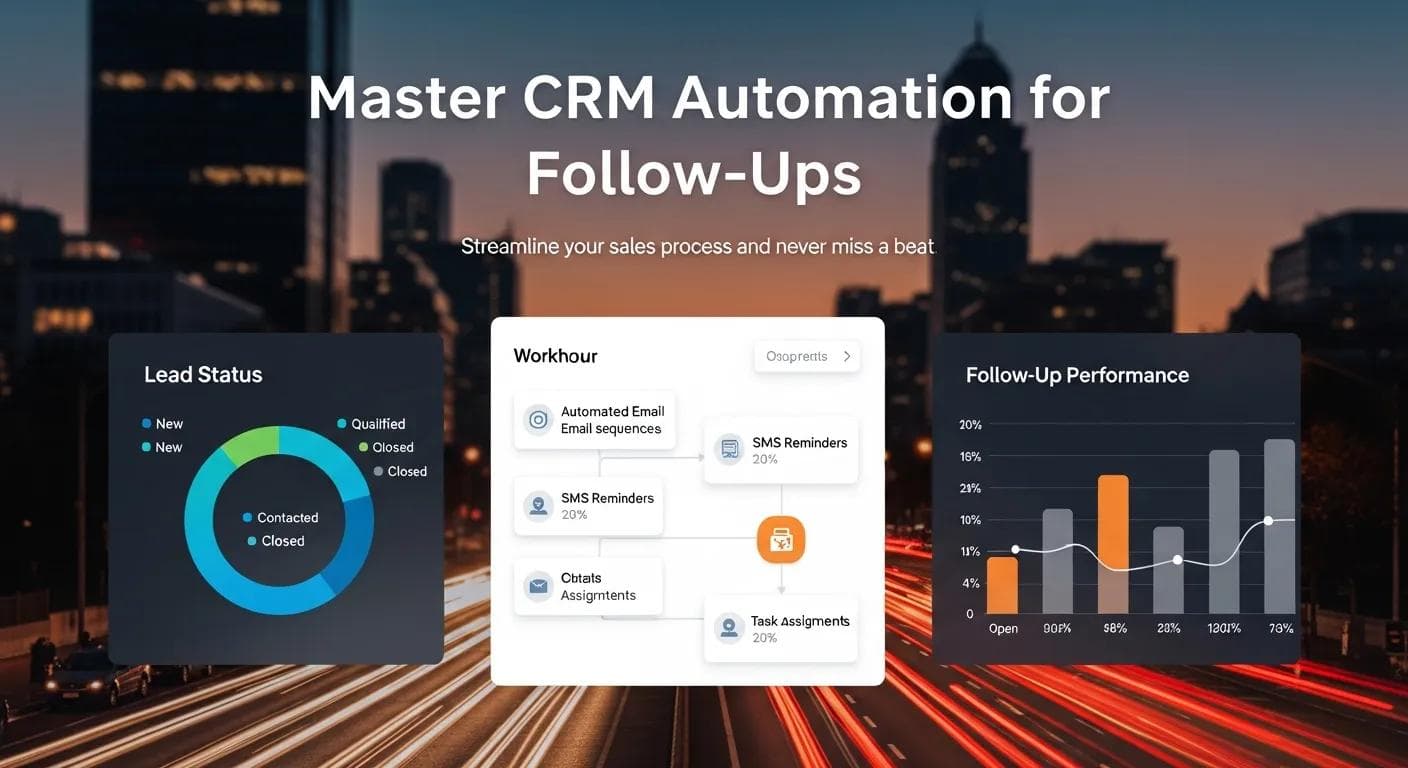

Master CRM Automation for Follow-Ups
In a crowded sales landscape, strong customer relationship management separates winners from the rest. CRM automation tools remove the heavy lifting from follow-ups so you never miss a promising lead. This guide shows how to put your CRM to work: automate timely, personalized follow-ups, keep leads engaged, and close more deals. You’ll learn the practical benefits of automated follow-ups, how AI sharpens those workflows, and clear steps to set up follow-up automation in your CRM — so your pipeline stops leaking to competitors.
Why automate follow-ups with your CRM?
Automating follow-ups keeps communication consistent and frees your team to focus on closing deals. Rather than tracking each touch manually, automation handles reminders, sequences, and personalized messages at scale. That reliability reduces slipped leads, improves engagement, and raises conversion rates — especially in fast-moving markets where timing and relevance matter.
What are the benefits of CRM follow-up automation?
CRM follow-up automation delivers practical, measurable gains for sales teams:
- Saves time and resources: Automation removes routine manual tasks so reps can spend time where it matters most.
- Enhances lead nurturing: Consistent, behavior-driven follow-ups keep prospects moving through the buyer journey.
- Increases conversion rates: Regular, relevant contact improves the odds of turning leads into customers.
For companies that implement CRM follow-up automation thoughtfully, the result is better sales performance and happier customers.
How do automated email follow-ups improve lead retention?

Automated email follow-ups keep leads engaged by delivering the right message at the right time. When emails are personalized to a lead’s behavior and preferences, they feel relevant — and that boosts response rates. Consistent outreach keeps your brand top of mind, and analytics help you refine messaging and timing so each touch becomes more effective.
How AI and machine learning enhance CRM follow-up automation

AI and machine learning add intelligence to automated workflows. They uncover patterns in customer data, predict which leads are most likely to convert, and recommend the best time and message for outreach. That means your automation can be both scalable and smart: prioritizing high-value prospects, personalizing content, and continuously improving through data.
Evidence from recent research shows AI-enhanced CRM tools can materially improve lead retention and operational results.
AI-Enhanced CRM for Automated Follow-Ups & Lead Retention
This paper reviews how AI-enhanced CRM systems are used in network marketing to automate processes, analyze data, and apply predictive models that influence distributor performance and customer satisfaction. The authors describe applications such as lead scoring, behavioral segmentation, automated follow-ups, and personalized recommendations. They conclude that distributors using AI-based CRM tools tend to identify high-potential prospects more accurately and maintain more consistent engagement with customers.
AI-Enhanced CRM Tools in Network Marketing: Adoption and Impact, 2025
What role does AI play in CRM lead nurturing?
AI automates personalization at scale. Machine learning analyzes interactions to tailor messages, predict next steps, and trigger the right outreach automatically. That targeted approach makes follow-ups more relevant, improves response rates, and frees salespeople to focus on relationship-building and closing deals.
Advanced techniques like Natural Language Processing deepen this personalization by interpreting sentiment and intent from customer interactions.
AI-Driven Lead Nurturing: NLP & Predictive Analytics for Engagement
This study explores how combining Natural Language Processing with predictive analytics improves lead nurturing and engagement. It addresses common challenges in digital marketing — inefficient qualification, uneven nurturing, and low conversion — and shows how NLP can surface sentiment, intent, and behavior from large interaction datasets. Predictive models then forecast future customer actions so teams can deliver truly personalized engagement.
Leveraging natural language processing and predictive analytics for enhanced AI-driven lead nurturing and engagement, M Singh, 2022
How does predictive lead scoring reduce lead loss?
Predictive lead scoring uses historical and behavioral data to rank prospects by conversion likelihood. That means your team spends time on leads with the highest payoff instead of chasing low-potential contacts. Implemented in a CRM, predictive scoring sharpens prioritization in real time and helps prevent missed opportunities caused by outdated, rule-based scoring.
The shift to AI-driven scoring represents a meaningful improvement in identifying and prioritizing valuable prospects.
AI Lead Scoring: Prioritizing High-Value Leads with Machine Learning
In sales, time equals money. Traditional rule-based lead scoring helps prioritize prospects but can be rigid and slow to adapt to changing buyer behavior. Integrating machine learning into lead scoring enables real-time assessment of lead quality, moving beyond fixed criteria to a model that learns and evolves — which reduces wasted effort and surfaces higher-value opportunities.
AI-driven lead scoring in salesforce: using machine learning models to prioritize high-value leads and optimize conversion rates, VK Tarra, 2024
What are the best sales follow-up software and CRM automation tools?
When choosing follow-up and automation tools, weigh features, integrations, ease of use, and cost. Popular, well-regarded options include:
- HubSpot CRM: Friendly UI and strong automation features make it a good fit for companies of many sizes.
- Salesforce: Highly customizable platform with deep automation and enterprise-grade capabilities.
- Pipedrive: Pipeline-focused CRM with intuitive tracking and simple automation for sales teams.
Each of these platforms can streamline follow-ups and boost sales efficiency when matched to your team’s needs.
Which CRM automation tools integrate AI-powered marketing packages?
Many CRM platforms now bundle or support AI-driven marketing features — from predictive scoring to automated campaign optimization. Notable examples include:
- Zoho CRM: Built-in AI analytics and automation tools to help optimize campaigns.
- Microsoft Dynamics 365: AI integrations to enhance engagement and streamline sales workflows.
- Freshsales: Offers AI-powered lead scoring and predictive insights to inform follow-ups.
Adding these AI capabilities can make your follow-ups more targeted and efficient.
How to choose the right sales follow-up software for your business?
Selecting the right tool means matching functionality to your goals and constraints:
- Key features: Ensure the software supports automation, reporting, and integrations you need.
- Budget considerations: Assess total cost of ownership, including onboarding and growth.
- User experience: Choose a platform your team can adopt quickly to avoid long ramp-up times.
Careful evaluation helps you pick a solution that improves follow-up efficiency without creating friction for your team.
How to set up automated follow-ups in your CRM: step-by-step guide
Setting up automated follow-ups is straightforward if you follow a clear process. Use this checklist to get started:
- Initial setup steps: Configure lead capture fields and ensure data flows into your CRM cleanly so personalization is possible.
- Customization options: Build follow-up templates and sequences that reflect your brand voice and address common lead needs.
- Testing and optimization: Run test sequences, review performance metrics, and iterate to improve open, click, and conversion rates.
These steps will help you deploy reliable, high-performing follow-up sequences that keep leads engaged.
What are the key steps to configure CRM lead management automation?
To configure lead management automation, follow these core steps:
- Defining lead stages: Map your sales stages so the CRM knows how to advance leads through the funnel.
- Setting up automation rules: Create triggers that send messages or assign tasks based on lead behavior and timing.
- Monitoring performance: Track outcomes and adjust rules to improve conversion and efficiency.
These building blocks create a predictable, scalable lead management process.
How to personalize automated follow-ups for better engagement?
Personalization makes automation feel human. Try these tactics:
- Using customer data: Pull name, company, behavior, and preferences into messages for relevance.
- Tailoring messages: Align follow-up content to where the lead is in the buyer journey and their specific needs.
- Timing of follow-ups: Trigger outreach based on actions and engagement patterns, not just fixed schedules.
Thoughtful personalization increases response rates and shortens sales cycles.
What case studies demonstrate success in CRM follow-up automation?
Real-world examples show clear gains from CRM automation: an established e-commerce retailer boosted conversions within three months after launching automated post‑lead sequences, and a B2B service provider cut lead loss by implementing targeted automated email campaigns. These cases illustrate how consistent, data-driven follow-ups deliver measurable results.
How have businesses stopped losing leads using CRM automation?
Businesses retain more leads when they automate timely, relevant communication and use analytics to prioritize outreach. Automated sequences ensure no lead gets forgotten, and predictive tools help teams concentrate on the highest-potential prospects. That combination — consistency plus smart prioritization — is how companies keep leads from slipping away.
What statistics show AI marketing automation effectiveness?
Research shows AI-driven automation lifts engagement and conversion metrics for many companies. Organizations using predictive analytics typically see better lead qualification and reduced lead loss, while AI-powered personalization often increases response rates. These findings support adopting AI where it complements your existing marketing and sales processes.
How do productized marketing packages simplify CRM automation adoption?
Productized marketing packages bundle templates, workflows, and integrations so teams can implement CRM automation faster. They reduce setup complexity with pre-built sequences and training, shortening the time to value. For small and mid-sized businesses, these packages lower the barrier to entry and make automation practical without deep technical resources.
What features do AI-powered marketing packages offer?
AI-powered packages typically include:
- Automation capabilities: Pre-built workflows that automate repetitive tasks and follow-ups.
- Analytics and reporting: Dashboards and insights to measure campaign performance.
- Integration options: Connectors to CRMs and marketing stacks for seamless data flow.
Those features simplify running smarter, data-driven follow-up programs.
How to apply productized marketing packages to automate CRM follow-ups?
Use this approach to leverage a productized package:
- Implementation steps: Choose a package that aligns with your goals, then follow its setup guide to integrate with your CRM.
- Customization options: Adjust templates and workflows so messaging matches your brand and buyer personas.
- Expected outcomes: Track performance and iterate; you should see faster setup, more consistent follow-ups, and improved lead engagement.
When applied correctly, these packages speed up automation adoption and produce measurable improvements in follow-up efficiency.
To further improve your CRM strategy, consider how to apply these insights to your business.

justin
Contributor