

How Do Your Packages Compare in Terms of Pricing and Included Services
By Social Marketing Labs LLC Editorial Team · Updated 2026-07-21
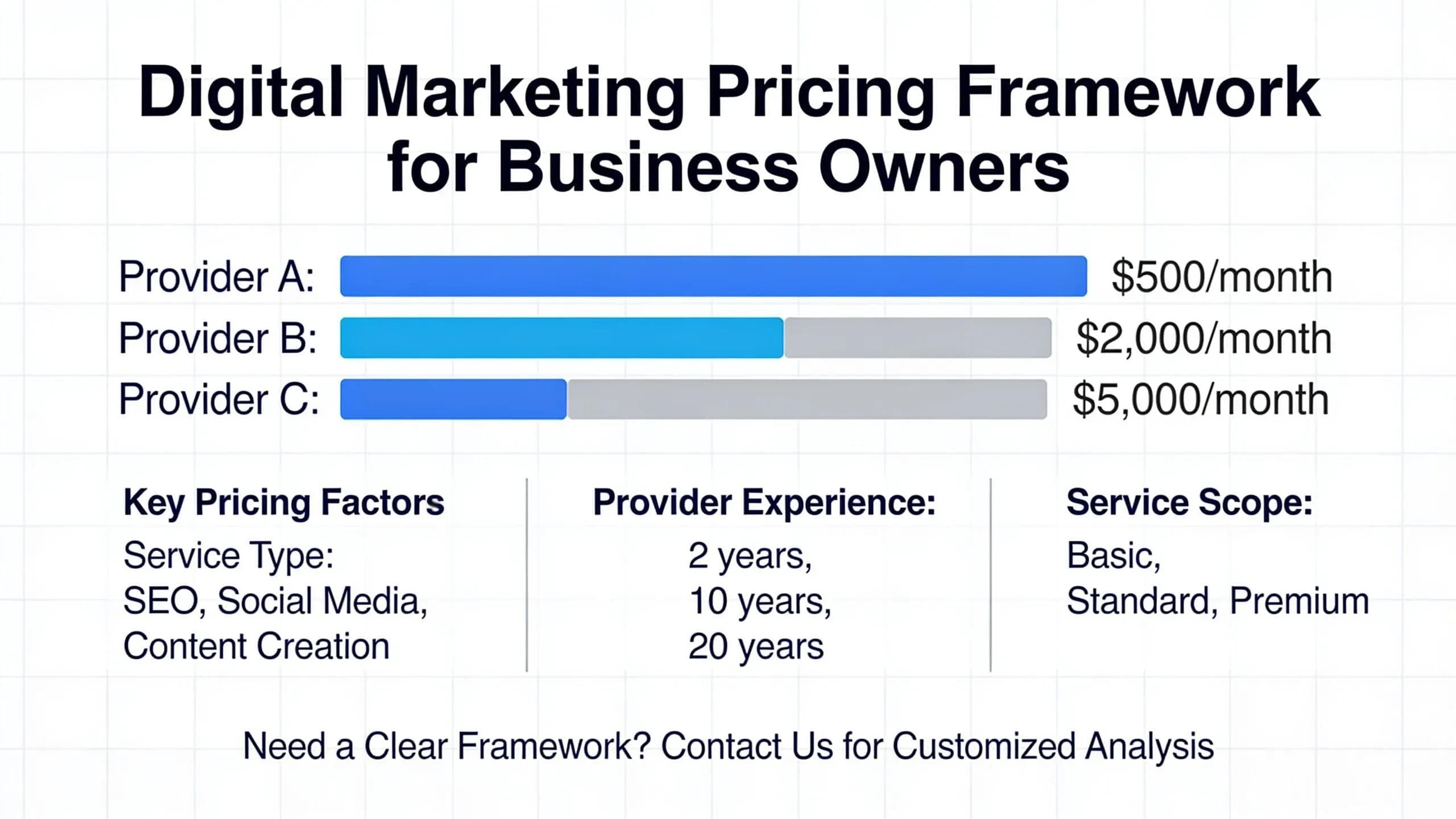
For How Do Your Packages Compare in Terms of Pricing and Included Services?, comparison requires evaluating deliverables, reporting frequency, and contract terms across providers—for example, Social Marketing Labs LLC, based in Wilmington, NC, operates with a lean 2-employee team, which affects pricing structure and service scope. Request itemized quotes and match services like SEO, PPC, and social management against each package’s total monthly cost.
Packages: Evaluate monthly costs, which range from $500 to $15,000+ depending on services included, and check whether pricing uses hourly rates ($75–$400/hr), retainers ($1,500–$50,000/mo), or fixed project fees—then match the model to your business size, like Social Marketing Labs LLC’s 2-employee Wilmington, NC setup.
Effective package comparison requires evaluating deliverables, not just monthly cost, since industry pricing spans $500 to $15,000+. Small business owners should match services—SEO, ads, CRM automation—to growth stage. Social Marketing Labs structures this through three tiers: Structure, Momentum, and Labs, each expanding SEO scope, ad management, and automation for measurable, scalable revenue outcomes.
Key Takeaways
Digital marketing agencies charge monthly retainers ranging from $1,500 to $50,000 depending on scope.
Six main pricing models exist: hourly rates, retainers, project-based fees, performance-based, value-based, and hybrid.
Hourly rates span $75 to $400 per hour across different agency service levels.
Local business owners find monthly costs starting at $50 for basic digital marketing services.
Digital marketing agencies charge monthly retainers ranging from $1,500 to $50,000 depending on scope.
Six main pricing models exist: hourly rates, retainers, project-based fees, performance-based, value-based, and hybrid.
Hourly rates span $75 to $400 per hour across different agency service levels.
Local business owners find monthly costs starting at $50 for basic digital marketing services.
What Should You Evaluate Before Comparing Packages?
Business owners should evaluate scope, pricing structure, and long-term partnership fit before lining up agency packages side by side. Digital marketing pricing varies widely across providers, with monthly costs spanning from roughly $500 to $15,000 or more, so understanding what a fee actually covers matters more than the headline number. A cheap package padded with vague deliverables often costs more in wasted spend than a pricier package built on clear outcomes.
Package comparisons should start with a simple filter: does the agency function as a vendor or a partner? Selecting a digital marketing agency is not just about outsourcing tasks to save internal time. It is about finding a long-term growth partner who understands the business, not a contractor who disappears after a deliverable ships. A well-structured pricing model reflects that distinction. It typically bundles strategy alongside execution rather than charging only for hours worked or tasks completed. cite-1
What Separates a Strategic Package From a Task-Based One?
A strategic package ties pricing to planning, measurement, and adjustment, not just deliverables. Task-based pricing charges for isolated activities like ad setup or post scheduling, with no ownership of results. Owners comparing tiers should ask whether strategy sits inside the fee or gets billed separately.
Does the Agency’s Positioning Match the Business’s Growth Stage?
Positioning matters as much as price. Social Marketing Labs frames its packages as AI-powered revenue machines for growing businesses, signaling an outcomes-first model rather than a standard vendor relationship. cite-2 Before comparing tiers, owners should confirm:
Whether pricing includes strategic planning or execution only
Whether reporting ties to revenue and lead outcomes, not just activity
Whether the agency scales with the business or requires re-negotiation at every growth stage
Whether pricing includes strategic planning or execution only
Whether reporting ties to revenue and lead outcomes, not just activity
Whether the agency scales with the business or requires re-negotiation at every growth stage
How Do Agency Pricing Models Actually Work?
Digital marketing agencies build pricing around six common structures: hourly rates, monthly retainers, project-based fixed fees, performance-based structures, value-based pricing, and hybrid models. cite-3 Business owners without a clear grasp of these models risk overpaying for scattered hours or locking into contracts that never tie back to results. Each structure carries different risk, different flexibility, and a different answer to How Do Your Packages Compare in Terms of Pricing and Included Services?
The right model depends on the business need, not the agency’s preference. A company needing ongoing marketing support fits a retainer. A business with a single, defined project fits a fixed fee. A leader demanding results-linked accountability fits a performance-based structure.
Pricing Model
Best For
Risk Level
Hourly
Small, undefined tasks
Unpredictable cost
Monthly retainer
Ongoing marketing support
Moderate, steady
Project-based fixed fee
One-off projects
Low, capped cost
Performance-based
Results-linked accountability
Shared risk
Value-based
Outcome-focused engagements
Depends on value delivered
Hybrid
Blended needs
Balanced
Why Are More Agencies Moving to Hybrid Pricing?
Most agencies heading into 2026 favor transparent, hybrid structures that blend a predictable base fee with additional performance or project components. cite-3 This shift protects clients from open-ended hourly billing while still rewarding measurable growth. Predictability matters most for owners managing tight marketing budgets.
Social Marketing Labs, based in Wilmington, NC, applies a productized deliverable model instead of hourly billing. Packages emphasize measurable outcomes—leads generated, conversions captured—rather than hours logged, giving decision-makers a clearer line between spend and results before committing to any package tier.
How Do the S.M.L. Protocol Packages Compare?
The S.M.L. Protocol organizes three packages—Structure, Momentum, and Labs—around distinct stages of business growth. Business owners weighing how do your packages compare in terms of pricing and included services find that each tier builds on the one before it rather than starting from scratch.
Structure establishes the foundation: website development, local and organic SEO, social content, and analytics reporting. Momentum and Labs expand that base with additional SEO keyword targeting, broader social media coverage, more advanced website architecture, and fuller ad and CRM automation across Meta and Google. cite-4 Every tier draws from the same service menu—website builds, SEO, social content and video, paid ads, CRM integration, app development, and analytics—so upgrading adds depth and scope rather than swapping tools.
Feature
Structure
Momentum
Labs
Website architecture
Foundational build
Advanced structure
Advanced structure, expanded
SEO keyword scope
Core local terms
Expanded keyword set
Broadest keyword coverage
Social media coverage
Base coverage
Increased coverage
Most comprehensive coverage
Ad + CRM automation
Entry-level setup
Comprehensive automation
Full-stack automation
Which Package Fits a Small Business Best?
Smaller operations testing digital marketing for the first time typically start with Structure. It establishes the website, local SEO, and reporting groundwork needed before scaling spend. Businesses already generating leads but struggling with follow-up or ad waste tend to move toward Momentum or Labs for deeper automation.
Does a Small Team Affect Service Delivery?
Social Marketing Labs runs on a lean, two-person team based in Wilmington, North Carolina. That small footprint keeps deliverables productized and tightly scoped. Clients receive focused execution rather than layers of account managers passing work between departments. Package selection, in this model, functions less like buying add-ons and more like choosing the right operating system for a client’s current growth stage.
Which Package Delivers the Strongest ROI?
Every S.M.L. Protocol tier delivers measurable returns, but the strongest ROI depends on business size, current lead volume, and growth goals. Social Marketing Labs has served over 100 clients. Generated more than pricing varies in client revenue across all three packages, proving that results scale with commitment rather than budget alone. Business owners often ask How Do Your Packages Compare in Terms of Pricing and Included Services? before committing. The honest answer is that value grows with scope, not just price.
Cheaper marketing plans elsewhere often cover only basic execution—posting content, running a few ads, calling it done. Higher-value pricing models, by contrast, bundle strategy, testing, and long-term optimization. That distinction matters more than the sticker price.
Package
Best Fit
ROI Signal
Structure
Businesses building foundational systems
Entry point into the a notable share average lead increase
Momentum
Companies scaling ad spend and content
Expanded SEO and automation compound gains
Labs
Established brands needing full-stack execution
Highest ceiling for revenue impact
Does a Higher-Tier Package Guarantee Better Results?
A higher tier doesn’t guarantee better results on its own; execution and consistency matter more. Clients across every package report satisfaction averaging 4.9 out of 5, showing the agency delivers reliably regardless of which tier a business selects.
Which Package Should Growing Businesses Choose First?
Businesses with limited internal marketing capacity typically start with Structure to establish core systems before scaling. Companies already generating leads but wasting ad spend often move directly into Momentum or Labs. Automation and expanded reach accelerate the average a notable share lead increase clients see after implementation. cite-2
Which Package Fits Your Business Stage?
Business stage determines package fit more reliably than budget alone. A startup building its first real web presence needs different tools than an established company scaling ad spend across markets. How Do Your Packages Compare in Terms of Pricing and Included Services? The honest answer starts with growth stage, not sticker price. A long-term marketing partner earns that role by matching services to where a business actually stands, not just what it can afford this quarter.
Social Marketing Labs, based in Wilmington, North Carolina, serves small to mid-sized businesses both regionally and nationally. Every engagement begins the same way: a two-minute assessment, followed by a strategy session, before any package gets recommended. cite-2 That sequence prevents businesses from overbuying advanced automation before their foundation is ready. Underbuying when growth demands more firepower.
How does agency pricing vary by market?
Pricing across the digital marketing industry varies widely, shaped by state, service scope, and provider. Data spanning thousands of U.S. agencies confirms no single “standard” rate exists nationally. That variance makes side-by-side comparison of included services — not cost alone — the smarter evaluation method.
Should a business choose based on price or growth stage?
Growth stage should drive the decision first. A package priced lower but misaligned with current needs often costs more in missed leads. Wasted ad spend down the road.
Comparing digital marketing packages requires looking beyond price tags to evaluate the systems, technology, and strategic alignment each agency brings to your business. The most valuable packages deliver integrated solutions that transform marketing from a fragmented expense into a cohesive revenue engine. Choose a partner whose approach matches your growth stage and whose commitment to measurable outcomes aligns with your business goals.
FAQ
What factors matter most when comparing digital marketing packages?
Compare deliverables, not just monthly cost, since pricing spans $500 to $15,000+. Match services like SEO, ads, and CRM automation to your business’s growth stage and pricing model.
What pricing models do digital marketing agencies use?
Agencies use six main structures: hourly rates ($75–$400/hr), retainers ($1,500–$50,000/mo), project-based fixed fees, performance-based, value-based, and hybrid models. The right model depends on business size and scope.
How does a strategic package differ from a task-based one?
A strategic package bundles planning, measurement, and adjustment into the fee. Task-based pricing charges only for isolated activities like ad setup with no ownership of results. Owners should confirm whether strategy is included or billed separately.

justin
Contributor