

How Can I Measure the Effectiveness of Your Marketing Solutions on My Revenue
By Social Marketing Labs LLC Editorial Team · Updated 2026-07-21
For How Can I Measure the Effectiveness of Your Marketing Solutions on My Revenue?, revenue impact measurement requires tracking AI marketing tool costs against campaign-attributed revenue gains, then applying the standard ROI formula: (Revenue − Investment) ÷ Investment × 100. Marketing leaders using structured productized systems, such as the S.M.L. Protocol’s lead-generation packages, gain clearer attribution paths, turning scattered vendor data into one measurable, executive-ready revenue narrative.
Key Takeaways
Calculate total AI costs including software, training, and implementation to establish baseline investment figures.
Attribution models measure only a fraction of marketing impact, creating measurement gaps in 2026 and beyond.
AI marketing ROI measurement proves financial returns essential for business survival and budget justification.
Traceable marketing footprints represent diminishing portions of actual marketing effectiveness in current measurement systems.
Calculate total AI costs including software, training, and implementation to establish baseline investment figures.
Attribution models measure only a fraction of marketing impact, creating measurement gaps in 2026 and beyond.
AI marketing ROI measurement proves financial returns essential for business survival and budget justification.
Traceable marketing footprints represent diminishing portions of actual marketing effectiveness in current measurement systems.
Why Is Measuring AI Marketing ROI So Hard?
Attribution gaps, not lack of data, cause most measurement failures. Seventy-four percent of companies still cannot show real ROI from their AI use, despite dashboards full of metrics. Marketing leaders often ask, How Can I Measure the Effectiveness of Your Marketing Solutions on My Revenue?, and the honest answer starts with admitting that vanity metrics rarely connect to dollars.
Complexity compounds the problem. AI tools generate leads, clicks, and impressions across dozens of touchpoints, but few systems trace those signals back to closed revenue. Marketing operations teams need clean data pipelines and disciplined benchmarks, not just more software.
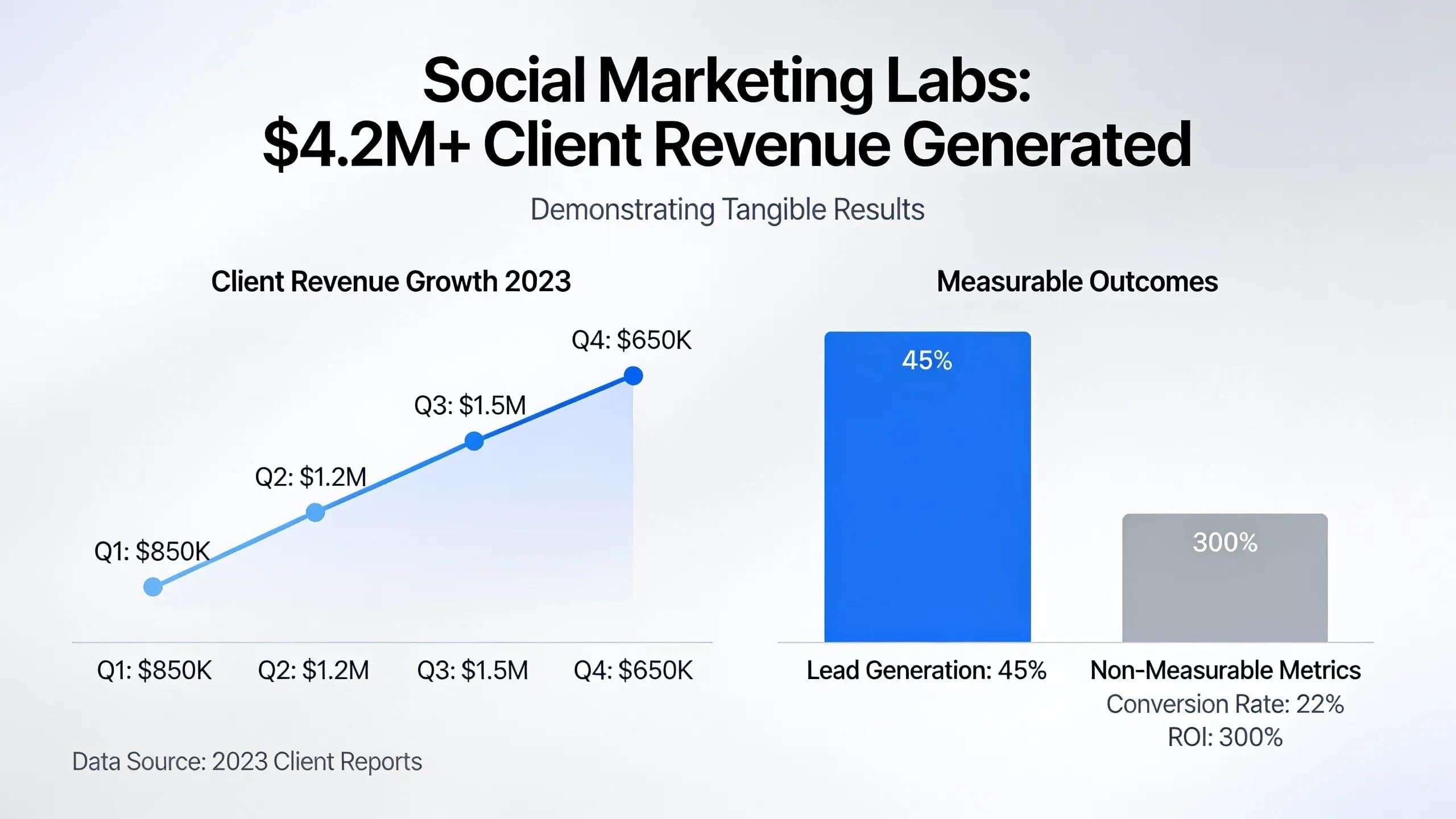
Social Marketing Labs addresses this gap through structure, not scale. The agency runs as a lean two-person team based in Wilmington, NC, which keeps deliverables productized and outcomes measurable instead of buried in agency overhead. That focus has produced over pricing varies million in documented client revenue, a figure built from tracked campaigns rather than projections.
What Metrics Actually Prove Marketing ROI?
Lead volume tied to closed deals proves ROI more reliably than impressions or engagement rates. Clients working with Social Marketing Labs average a a notable share lead increase, a benchmark tied directly to pipeline growth rather than surface-level traffic.
Why Do So Many AI Marketing Tools Fail the ROI Test?
Most platforms optimize for activity, not attribution. They report clicks and opens instead of revenue-linked outcomes, leaving finance teams without a clear cost-per-lead or cost-per-close story.
Common measurement failure points include:
Disconnected CRM and ad platform data
No defined revenue benchmark before launch
Attribution models built for clicks, not closed deals
Reporting cycles too infrequent to catch underperformance early
Disconnected CRM and ad platform data
No defined revenue benchmark before launch
Attribution models built for clicks, not closed deals
Reporting cycles too infrequent to catch underperformance early
Fixing these gaps requires consistent tracking, not another dashboard.

How Can I Measure the Effectiveness of Your Marketing Solutions on My Revenue?
How can I measure the effectiveness of your marketing solutions on my revenue starts with a documented baseline, not a guess. Social Marketing Labs builds that baseline through a consultative onboarding process beginning with a two-minute assessment, followed by a strategy session before any package launches. Marketing leaders gain a clear starting point for revenue, cost, and lead volume before implementation begins. That baseline becomes the yardstick every later report gets measured against.
From there, measurement follows a repeatable formula. Calculating total campaign costs — software, setup, ad spend — comes first. Revenue gains tied to those campaigns get tracked next. Applying the standard ROI formula, (Revenue minus Investment) divided by Investment, multiplied by 100, converts raw numbers into a percentage finance teams can compare across quarters and channels.
What steps prove marketing ROI to finance leadership?
Finance teams respond to consistent methodology, not one-off wins. A defensible process includes:
Documenting total investment across tools, labor, and ad spend.
Tracking revenue directly attributable to each active campaign.
Running the ROI formula on a fixed schedule — monthly or quarterly.
Comparing results against the pre-implementation baseline set during onboarding.
Documenting total investment across tools, labor, and ad spend.
Tracking revenue directly attributable to each active campaign.
Running the ROI formula on a fixed schedule — monthly or quarterly.
Comparing results against the pre-implementation baseline set during onboarding.
Does client satisfaction data confirm measurable revenue results?
Satisfaction scores back up the numbers rather than replace them. Social Marketing Labs reports strong client satisfaction scores, a figure tied directly to clients hitting documented revenue goals. Marketing operations managers can treat that score as a signal: consistent ROI reporting correlates with consistent client outcomes.
Together, the baseline assessment, cost tracking, and ROI formula give demand-gen teams a reporting structure built for executive review — not internal guesswork. Skipping any one step weakens the case for continued budget.

What Metrics Actually Prove Revenue Impact?
Conversion rates and lead quality separate real revenue growth from vanity dashboards. Marketing leaders asking How Can I Measure the Effectiveness of Your Marketing Solutions on My Revenue? need a short list of numbers finance actually trusts, not a spreadsheet full of impressions.
Two figures matter most. Conversion rates show how many visitors turn into paying customers. Lead quality shows whether those conversions are worth pursuing at all. A campaign can generate hundreds of leads and still lose money if the leads never close.
Social Marketing Labs’ package structure builds analytics and reporting directly into the deliverable. Clients track improved Core Web Vitals scores — page speed, responsiveness, visual stability. Alongside lead volume, so technical performance and pipeline growth sit on the same report. That pairing matters for CMOs who need to defend both the tech stack and the ad budget in one meeting.
Which Numbers Should Marketing Ops Report to Finance?
Marketing operations teams get the clearest answer by isolating cause from correlation. Attribution models help separate revenue actually driven by AI-powered campaigns from gains that would have happened anyway through organic or branded search. Without that isolation, credit gets assigned to the wrong channel, and budget follows it.
A practical monthly report includes:
Conversion rate by channel and campaign
Lead quality score or close rate
Core Web Vitals trend over time
Attributed revenue versus total revenue
Conversion rate by channel and campaign
Lead quality score or close rate
Core Web Vitals trend over time
Attributed revenue versus total revenue
Social Marketing Labs’ productized model reinforces this discipline. The firm’s packages emphasize measurable outcomes over hours billed, which forces cost and results onto the same page from day one. A structure demand-gen teams can hand straight to the CFO without translation.

How Does Attribution Break Down in 2026?
Attribution breaks down in 2026 because traditional models miss revenue signals hiding in plain sight. Search Console impressions climb for many brands while organic clicks stay apartment or slide downward. Marketing leaders staring at that gap often assume their tracking is broken. It isn’t.
Why does organic traffic look apartment when search visibility is rising?
The disconnect isn’t a data problem — it’s a mental model problem. AI-influenced buyers research differently now: they see a brand in search results, get an answer without clicking, then arrive later through direct or branded search. Attribution tools built for a click-by-click journey can’t credit a path that skips clicks entirely. Marketing leaders who keep reading last-click reports as gospel will chase the wrong budget conclusions.
Where can marketing leaders find the missing revenue signal?
CRM integration and automation fill part of that gap. By capturing lead-handling data across the entire funnel — not just the first ad click. CRM systems reveal conversion patterns that ad-platform dashboards never see. Social Marketing Labs structures campaigns so this visibility isn’t an afterthought.
That structure matters because fragmented reporting is the real enemy. AI-driven SEO and paid advertising on Meta. Google, when built correctly, should feed into one integrated reporting stack instead of three disconnected vendor exports. Consider the two models side by side:
Reporting Approach
What It Shows
What It Misses
Fragmented vendor reports
Platform-specific clicks and spend
Cross-channel lead journeys, CRM outcomes
Integrated reporting stack
SEO, paid, and CRM data combined
Little, when aligned to actual buyer paths
For CMOs justifying spend to finance, that consolidated view is the difference between guessing and reporting.
What Should You Do Next to Protect Your Budget?
Protecting marketing budget starts with defining success before a single dollar gets spent. Clear, specific campaign objectives set from the outset make How Can I Measure the Effectiveness of Your Marketing Solutions on My Revenue? a far easier question to answer for finance teams and executives. Vague goals produce vague reports; specific ones produce defensible numbers.
Social Marketing Labs begins every engagement with a two-minute assessment and a follow-up strategy session. That step exists to define exactly which metrics will count as proof of revenue impact before implementation begins. Skipping this step is how marketing teams end up defending spend after the fact instead of proving it in real time.
How does package selection affect measurement accuracy?
Choosing the wrong package for a business’s growth stage weakens the data available for ROI reporting. Social Marketing Labs has served 100+ clients through a tiered model. Structure, Momentum, and Labs — built to scale measurement depth alongside company growth. Smaller operations get foundational tracking; larger ones get deeper attribution and reporting layers.
Why does vendor fragmentation hurt ROI reporting?
Multiple disconnected vendors create multiple disconnected data sets. The S.M.L. Protocol replaces that fragmented setup with one integrated stack, cutting down on the reporting inconsistencies that muddy revenue calculations.
Before renewing any AI marketing contract, marketing leaders should confirm three things:
Objectives were defined in specific, measurable terms from day one
Reporting comes from one unified system, not several conflicting dashboards
The current package still matches the company’s growth stage and data needs
Objectives were defined in specific, measurable terms from day one
Reporting comes from one unified system, not several conflicting dashboards
The current package still matches the company’s growth stage and data needs
Budgets stay protected when measurement gets built in early, not bolted on later.
Measuring the revenue impact of AI marketing solutions requires discipline, clear metrics, and integrated systems that connect every touchpoint to business outcomes. When you align your technology stack, automate lead handling, and track conversions from first click to closed deal, the data tells a compelling story—one that transforms marketing from a cost center into a predictable revenue engine. The businesses that win aren’t those chasing vanity metrics. They’re the ones who commit to systematic measurement and let the numbers guide their next move.
FAQ
What formula calculates AI marketing ROI?
The standard formula is (Revenue − Investment) ÷ Investment × 100. This requires tracking total AI tool costs against campaign-attributed revenue gains for an accurate, executive-ready result.
Why do most companies fail to prove AI marketing ROI?
Attribution gaps cause the failure, not missing data. Seventy-four percent of companies show no real ROI from AI despite full dashboards. Vanity metrics rarely connect to actual dollars.
What baseline does Social Marketing Labs use before measuring impact?
The two-person Wilmington, NC team documents revenue, cost, and lead volume through a two-minute assessment and strategy session before launch, creating the yardstick for every later report.

justin
Contributor