
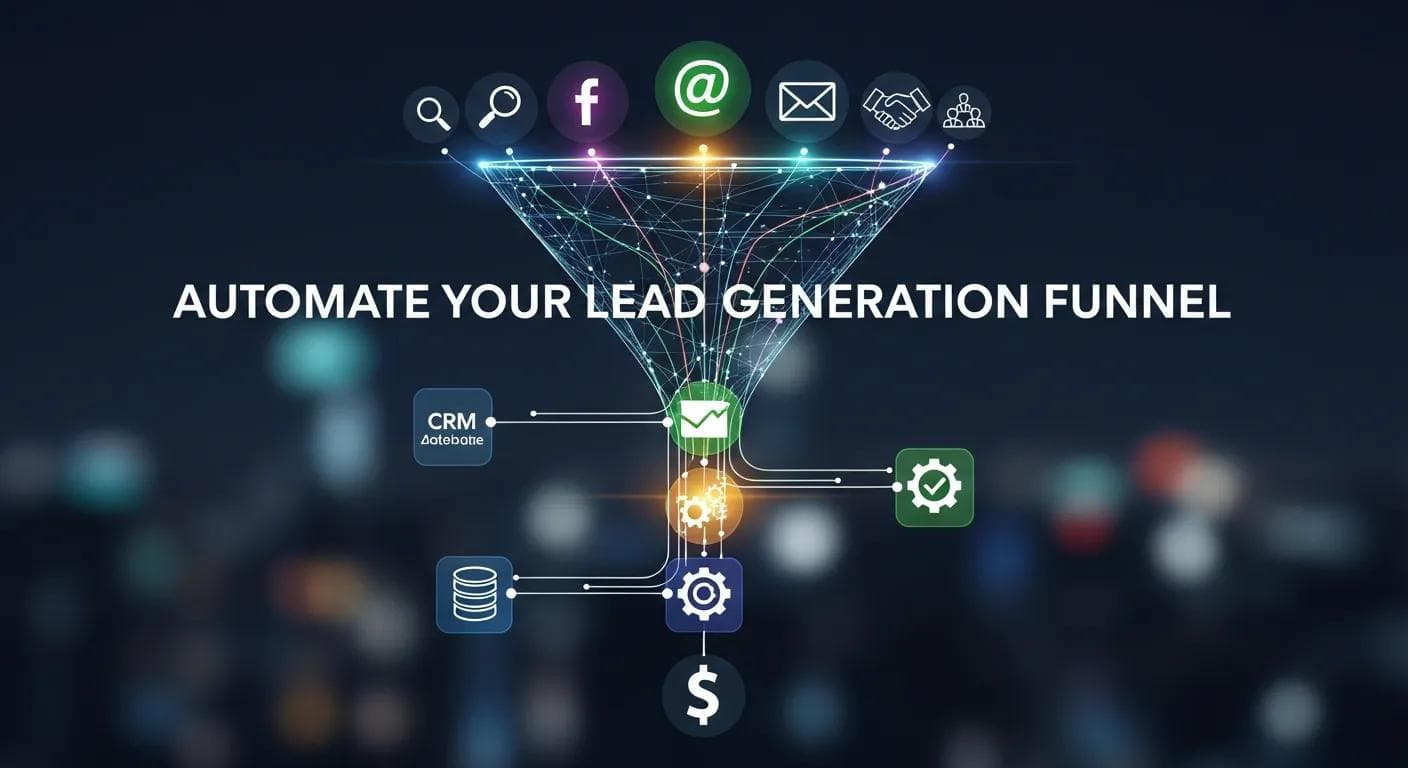

Automate Your Lead Generation Funnel
A predictable lead generation funnel is the foundation of steady growth. A clear, well-designed funnel attracts prospects, guides them through the buyer’s journey, and converts interest into revenue. Below we break down each funnel stage, explain how AI-driven automation improves performance, and share practical optimization steps you can use to keep your sales pipeline full. You’ll also find the key metrics to measure, the tools that help, and examples of AI in action so you can apply what works for your business.
What Are the Essential Sales Funnel Stages for Effective Lead Generation?
A sales funnel maps the steps a prospect takes from discovering your brand to becoming a customer. Knowing these stages helps you design targeted campaigns and measure results. The core stages are:
- Awareness Stage: When prospects first encounter your brand. Use content, ads, and social to create visibility and spark interest.
- Consideration Stage: Prospects compare options and evaluate value. Helpful content—case studies, comparisons, and testimonials—builds credibility and trust.
- Decision Stage: Prospects are ready to buy. Clear CTAs, trials, demos, or limited-time offers remove final friction and drive conversions.
These stages form the structure for your lead generation system, letting you match messages and tactics to where someone is in their journey.
How Does Each Stage Contribute to Filling Your Sales Pipeline?
Each funnel stage plays a distinct role in creating a steady flow of qualified leads:
- Awareness: Brings new prospects into the top of the funnel. Broad-reach channels and useful content increase discoverability and initial interest.
- Consideration: Nurtures and qualifies leads. Educational resources and social proof move prospects closer to purchase by addressing objections and proving value.
- Decision: Converts interest into customers. Personalized outreach, timely offers, and simplified purchase paths convert intent into revenue.
When you optimize each stage, you improve the quality and volume of leads entering your sales pipeline.
What Are the Key Metrics to Measure Funnel Stage Performance?
Tracking the right metrics tells you which stages need attention. Focus on metrics that reflect movement and efficiency across the funnel:
Use these metrics together to pinpoint leaks and prioritize improvements.
How Can AI Marketing Automation Enhance Small Business Lead Generation?

AI marketing automation reduces manual work and makes your outreach smarter. Automations handle repetitive tasks—email sequences, ad bidding, social posting—while AI analyzes behavior to deliver more relevant messages. The result: higher engagement, better-qualified leads, and more predictable conversions without adding headcount.
Our Lead Generation services are built around this principle: combine automation with human strategy to design funnels that scale. With AI doing the heavy lifting—segmentation, scoring, personalization—your team focuses on strategy and closing deals.
What AI Technologies and Machine Learning Algorithms Drive Funnel Optimization?
Several AI tools and algorithms power smarter funnels. Key examples include:
- Predictive Analytics: Uses historical data to forecast which leads are most likely to convert so you can prioritize outreach.
- Natural Language Processing (NLP): Interprets customer messages and content interactions to improve targeting and personalize communication.
- Machine Learning Algorithms: Continuously learn from interactions to refine segmentation, timing, and channel mix for better performance.
Combining these approaches—especially reinforcement learning with predictive models—lets systems adapt in real time and optimize marketing actions as behavior changes.
AI-Enhanced Marketing Funnel Optimization with RL & Predictive Analytics
This study examines how reinforcement learning (RL) and predictive analytics can be integrated to improve conversion rates and engagement across a marketing funnel. RL provides a framework for dynamic decision-making, allowing marketing actions to adapt to live customer interactions and shifting market conditions. Predictive analytics segments and forecasts customer behavior, feeding more accurate inputs to the RL model and accelerating its learning.
Leveraging Reinforcement Learning and Predictive Analytics for AI-Enhanced Marketing Funnel Optimization, 2022
How Does Predictive Lead Scoring Improve Lead Nurturing Strategies?
Predictive lead scoring ranks prospects by their likelihood to convert, so sales and marketing can focus on the highest-value opportunities. By analyzing demographics, behavior, and engagement signals, predictive scores surface leads that merit immediate attention and those that need more nurturing—improving efficiency and conversion outcomes.
Recent work shows AI scoring outperforms static rule-based systems by detecting subtle patterns that human-defined rules often miss.
AI-Driven Lead Scoring for Sales Funnel Optimization
AI changes lead scoring by applying machine learning to real-time data, enabling platforms like Salesforce to assess lead quality dynamically rather than relying solely on fixed rules. These models uncover nuanced patterns in large datasets, producing more accurate predictions about which leads will convert.
AI-driven lead scoring in salesforce: using machine learning models to prioritize high-value leads and optimize conversion rates, VK Tarra, 2024
Which Pipeline Management Tools Best Support Consistent Lead Flow?

Pipeline tools keep leads organized and help teams act quickly. Popular options include:
- HubSpot: An all-in-one CRM with built-in marketing automation and clear pipeline visibility.
- Salesforce: Highly customizable, with advanced analytics and enterprise-grade integrations.
- Pipedrive: Visual, sales-focused pipeline management that makes it easy to track deals and next steps.
Choose a tool that fits your team’s size, process complexity, and reporting needs to sustain consistent lead flow.
How Do CRM Integrations Streamline Sales Pipeline Management?
Integrations connect your marketing, sales, and support data so everyone works from the same customer picture. That centralization speeds follow-ups, reduces data friction, and lets automation trigger the right actions at the right time—improving lead handoffs and conversion rates.
What Features Should Small Businesses Look for in Pipeline Tools?
When evaluating pipeline tools, prioritize features that reduce friction and scale with you:
- User-Friendly Interface: Simple navigation shortens onboarding and keeps teams productive.
- Customization Options: Tailor stages, fields, and workflows to match your sales process.
- Reporting Capabilities: Actionable reports and dashboards reveal where to invest effort for the biggest impact.
These capabilities help small businesses adopt tools quickly and get measurable benefit fast.
What Are Proven Lead Nurturing Strategies to Maximize Funnel Conversion?
To move more leads through the funnel, use these proven nurturing tactics:
- Personalization: Use behavior and profile data to serve relevant content and offers that feel timely and useful.
- Multi-Channel Approaches: Combine email, social, paid media, and on-site experiences so your message reaches leads where they engage.
- Follow-Up Strategies: Sequence timely touchpoints—automated but personalized—to keep your brand top of mind and reduce drop-off.
Consistent, relevant contact at each stage increases conversion rates without overwhelming prospects.
How Does AI Personalization Enhance Lead Engagement?
AI-driven personalization delivers the right message to the right person at the right time by analyzing interactions and preferences. That precision increases open and click rates, shortens sales cycles, and builds stronger customer relationships through more relevant experiences.
What Are Effective Multi-Channel Nurturing Techniques?
Effective nurturing uses the channels your audience already prefers. Key techniques include:
- Email Marketing: Triggered, behavior-based emails that match each stage of the buyer journey.
- Social Media Engagement: Timely interactions and targeted content to keep leads engaged and informed.
- Content Marketing: Helpful, problem-focused content that answers questions and builds trust across the funnel.
Layer channels strategically so each touchpoint advances the relationship.
How to Measure and Optimize Your Lead Generation Funnel Performance?
Continuous testing and measurement are essential. Start with these practices:
- Tracking Key Metrics: Regularly review conversion rates, acquisition costs, and lead velocity to monitor health and trends.
- A/B Testing: Test headlines, offers, CTAs, and timing to find what increases conversion at each step.
- Gathering Feedback: Ask leads and customers for input to surface friction points and opportunities for improvement.
Iterate on insights to steadily improve funnel efficiency and ROI.
Which KPIs Indicate Funnel Health and Sales Pipeline Growth?
Monitor these KPIs to understand funnel health and revenue momentum:
- Conversion Rates: Show how well prospects move through each stage.
- Lead Retention Rates: Measure ongoing engagement and the long-term value of leads.
- Sales Growth Metrics: Track revenue and deal velocity to assess commercial impact.
Together, these metrics reveal where to optimize for faster growth and better pipeline quality.
How Can Data-Driven Insights Guide Funnel Improvements?
Data helps you identify which segments, messages, and channels perform best. Use analytics to test hypotheses, reallocate budget toward high-impact tactics, and refine targeting—with the goal of increasing efficiency and lowering acquisition cost over time.
What Are Localized AI Marketing Success Stories from Wilmington NC Businesses?
Local examples show how AI can work in small markets. In Wilmington, businesses used AI to analyze customer patterns and tailor offers, which led to higher foot traffic and measurable sales gains. These stories prove AI isn’t just for large enterprises—when applied correctly, it can drive meaningful results for local businesses too.
How Have Productized Marketing Packages Delivered Measurable ROI?
Productized marketing packages bundle repeatable services—content, social, lead generation, and analytics—into predictable, measurable programs. That structure makes it easier to track ROI and scale what works. For example, Social Marketing Labs offers packaged solutions that combine strategy, automation, and reporting so businesses can see clear, repeatable results.
To explore whether a packaged approach fits your needs, start with a discovery and testing plan that proves value before scaling.
To learn more about our process or to get started, visit the application page at Social Marketing Labs.
What Lessons Can Wilmington Businesses Learn from AI-Powered Funnels?
Wilmington businesses can benefit from three core lessons: prioritize data-driven decisions, automate where it reduces manual work, and continually optimize based on results. With those practices, small teams can compete more effectively by delivering timely, relevant experiences that convert.
If you’re ready to level up your funnel, Social Marketing Labs can help you design and implement an AI-driven lead generation system that consistently fills your sales pipeline.
Ready to see how Social Marketing Labs can transform your marketing? Apply today and start building a more effective, predictable lead generation strategy.

justin
Contributor